

GENERAL INFORMATION
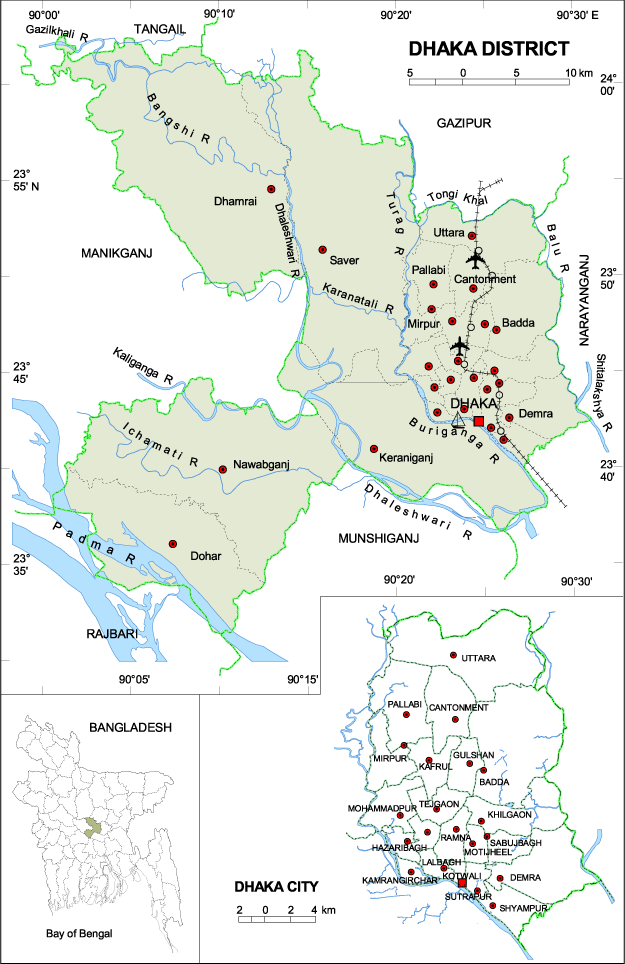 Dhaka is in the centre and the capital of Bangladesh. This division has an area of 31,120 Square Kilometer and a population of 40 million. It is bounded by Indian state of Meghalaya in the north, Barisal and Chittagong divisions in the south, Sylhet division in the east, and Rajshahi & Khulna divisions in the west. Dhaka is the entrance to most of the international tourists who fly to Bangladesh, since we have our main international airport in this town.
Population distribution of this division is male 51.63%, female 48.37%; Muslim 89.51%; Hindu 9.64%, Christian 0.5%, Buddhist 0.03% and others 0.32%.
The division is mostly plain and consists of cultivable land. We grow Paddy, jute, wheat, potato, ground nut, onion, garlic, chilly, various kinds of pulse, sugarcane, and vegetables. Mango, jackfruit, papaya, pineapple, guava, watermelon, coconut and banana are among produced fruits of Dhaka.
This division is ideal for Photography Tours, Nature Tours, Architectural Tours, River Tours, Monsoon Tours, and Walking Tours.
Dhaka has got the major international airport of Bangladesh that makes it the gateway for most of the inbound tourists of Bangladesh
MAJOR ATTRACTIONS
Lalbagh Fort
Lalbagh Fort is an incomplete Mughal palace fortress at Dhaka by the river Buriganga. The river has now gone further south and flows at quite a distance from the fort. The construction of the fort was commenced in 1678 AD by Prince Muhammad Azam and was left unfinished since 1684. At the centre of the fort stands the Tomb of Pari Bibi, the beloved daughter of Shaista Khan. On the western side of the tomb stands the Mosque and the Diwaan-e-aam along with the hummam khana is in the east. The fort has a huge tank and residence for the soldiers and officials in the inner side of the southern wall.
Star Mosque
Star Mosque is situated in Abdul Khairat Road, Armanitola, in the old part of Dhaka City. Mirza Golam Pir built a three domed mosque in the 19th Century. In 1926 a local businessman named Alijan Bepari added a verandah to the mosque, and even later in the 1987, Bangladesh Government added two more domes with it making a five domed mosque. Star decoration on its domes gave it such a name.
Armenian Church
Situated in the present day Armanitola of the old part of Dhaka, it is a church established in 1781 by the Armenian community who came to Dhaka in 17th Century to trade with jute and salt. Though the community started moving off the region since the beginning of British rule and disappeared by the early of 20th Century, but the church is still in use by local Christian community.
Rickshaw
Rickshaw is one of the principal means of transport in the urban areas of Bangladesh. It was first introduced in Japan in the early twentieth century. European jute exporters living in Narayanganj and Netrokona had first imported cycle rickshaw from Calcutta in 1938 for their personal use. Only 37 rickshaws were there in Dhaka in 1941, but now the city has about 600,000 rickshaws. Apart from its vehicular value, it is one of the fascinating tourist attractions of Dhaka.
Curzon Hall
This structure was built in 1904. Meant to be a town hall and was named after Lord Curzon, the then British Viceroy in India. It was used as such till 1911, when the partition of Bengal was annulled. Following the annulment of partition in 1911 it was used as a premise of Dhaka College, and after the establishment of Dhaka University in 1921, became part of the university's science section and continues as such.
The building has a happy blend of European and Mughal elements, particularly noticeable in the projecting facade in the north which has both horse-shoe and cusped arches. The style combined traditional art with modern technology and functions and favoured Mughal forms such as arches and domes, believed to have entered the Islamic world from the west.
Liberation War Museum
Liberation War Museum collects preserves and displays the objects, artifacts and all other materials related to the War of Liberation of Bangladesh against Pakistan in 1971. It was inaugurated on 22 March 1996 at 5 Segun Bagicha, Dhaka in a two-storied old-sty1e building. There is an eternal flame at the entrance.
The museum has six galleries the first of which demonstrates the Customs & Traditions of Bengal as well as the struggle against colonial control. The second gallery presents a chronicle of the period of the Pakistani rule from 1947 and especially, the political, economic and cultural oppression on the people of East Pakistan and the resistance against it. The third gallery shows relics of the non-cooperation movement of March 1971, the genocide and resistance, declaration of independence and the plight of the Refugees. The three galleries on the second floor display documents and materials that show various aspects of resistance by the people of East Pakistan, international solidarity to them, the killing of intellectuals by Pakistan Army and its collaborators, and the victory of the Bengali people.
National Museum
The Bangladesh National Museum preserves and displays the cultural property and heritage, as well as specimens of natural history of Bangladesh. It is located at Shahbagh, Dhaka. The museum is well organized. Itwas formally inaugurated on March 20, 1913.
The four-storied building of the museum has 43 galleries on a total floor space of 238,000 square feet. It has a collected 82,475 objects. The most significant objects are ancient petrified wood (2.5 million years old) collected from lalmai and mainamati; blackstone Naga Darwaza (serpent doorway) of 10th-11th century collected from Bangarh, Dinajpur; pieces of atom bombs blasted in Hiroshima and Nagasaki, Japan in 1945; mat made of ivory; objects of the Liberation War of Bangladesh; objects used by the martyrs of the language movement; muslin of Dhaka; items of folk art and crafts; coins of emperor Sher Shah; terracotta plaques; sculptures and collection of contemporary art including various types of statues.
Language Martyrs’ Memorial
‘Shahid Minar’ in Bangla, was built in the memory of the martyrs who were killed in the 21st February of 1952 during the Language Movement of Bangladesh, then East Pakistan. Language Movement, being the first ever revolt against then Pakistani rulers, is a symbol of our courage and dignity and hence the memorial is of high significance to our society and life.
Dhakeshwari Temple
The Dhakeshwari temple was built in the 12th century by Ballal Sena, a king of the Sena Dynasty, and many say the name of the city was coined after this temple. This is a complex of several temples and ancillary buildings. The main temple is situated in the inner quarter on the east. A wall separates this quarter from the outer wall and entered through a monumental gateway, a bell adorns its top. The female deity has got the epithet dhakeshwari as the patron deity of the city of Dhaka (dhaka + ishvari).
Buriganga River
Buriganga is a very small river of only 27 km long. On average the river is 400m wide and 10m deep. It is a tributary of the mighty Brahmaputra River, which is called Jamuna in Bangladesh. Dhaka, the capital city of Bangladesh is situated by this river. Majority of the water transports linking Dhaka to the southern part of Bangladesh use this river. Sadarghat is the main terminal, while Damra is also used for minor purposes.
National Parliament Building
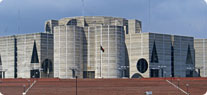
Bangladesh National Parliament Building is one of Luis I Kahn's master creations. Some says this is one of the most significant monumental buildings in the history of mankind. The construction began in 1964, and with a gap during the independence war in 1971, it was completed in the 1982.
Boktarpur Snake Market
This is the only such market in the known periphery of Dhaka. It attracts hundreds of people most of who are not necessarily buyers of snakes. It is a weakly market holding in every Friday.
Dhamrai
Dhamrai is a little town beside Dhaka mainly known for the Brass metal workshop that uses the ‘Lost Wax’ method to produce show pieces. There is a Pottery village very close to the town. The other reason for the town to be so popular is the Chariot Rally celebrating the birth of Krishna, one of the nine incarnations of Lord Visnu.
National Martyrs’ Memorial
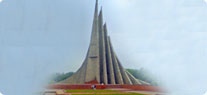
National Martyrs' Memorial situated at Savar, about 35 km north-west of Dhaka, symbolises the valour and sacrifice of the martyrs who sacrificed their lives for the liberation of Bangladesh. The main monument is composed of seven isosceles triangular planes each varying in size in its height and base. The highest one has the smallest base while the broadest base has the lowest height. The planes are folded at the middle and placed one after another. The highest point of the structure reaches 150 feet. This unique arrangement of the planes has created a structure that seems to change its configuration when viewed from different angles.
The whole complex is spread over an area of 34 hectares (84 acres) which is again wrapped around by a green belt of 10 hectares (24.7 acre). Several mass-graves and a reflection water body are placed in front of the monument.
Sonargaon
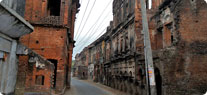
The ‘village of Gold’ is the literal meaning of the name. Since before 11th Century, this has been a very important trading centre in the region for a long time till 17th Century, when Dhaka was made the capital of Mughals. During its long glorious history the town has seen several kings and rulers of different origins and religions.
The ancient city has been traced to have embraced a wide tract bounded on the east, west and south by the Rivers Meghna, the Shitalakhya and the Dhaleshwari respectively and on the north by the Brahmaputra River. It is now a township in the name of an upazila about 27km southeast of Dhaka in the Narayanganj district. Ancient city of Panam Nagar and few majestic buildings are the attractive remains of its old glory.
Murapara Jamindar’s Palace
Situated in a very calm and tranquil area on the bank of Buriganga River, this double storied palace is a 20th Century structure. Local tax collectors were called ‘Jamindars’ and since the palace was built by the Jamindar, it is commonly known as the Murapara Jamindar’s Palace. Currently this building is being used as the premise for local degree college.
Birishiri
Shusong Durgapur of Birishiri is located at Netrokona about 170 km north from Dhaka. It’s not only blessed by charismatic natural beauty, is also reach in ethnic culture as there are many ethnic groups like – Hajong, Garo, Achik and Mandi etc lives here. Many people around the world come here to learn the ethnic culture and livings.
The main attraction of Birishiri is the ceramic hill of Durgapur and the picturesque landscape along the Shomeshwari River.
Ahsan Manjil
Ahsan Manzil is situated at Kumartoli of Dhaka on the bank of the Buriganga, was the residential palace and the kachari of the nawabs of Dhaka. Having purchased it from his son Matiullah, the French made it their trading centre. Khwaja Alimullah bought it from the French in 1830 and converted it into his residence, effecting necessary reconstruction and renovations. Nawab Khwaja Abdul Ghani renovated it in the third quarter of 19th Century and named after his son Khwaja Ahsanullah. It has been turned into a museum recently.
Tomb of Sk. Mujibur Rahman
Born on 17 March 1920 in the village Tungipara, Gopalganj, Sheikh Mujibur Rhman joined in active politics in 1949 and was very prominent and bold figure during Pakistani rule in Bangladesh. Eventually he became the most supreme leader for the country during the more than 9 months long war against Pakistan. He was given the title “Bangabandhu” which means the ‘Friend of Bengal’ in 1969. He was the first President of independent Bangladesh and is called the father of the nation. This prominent leader, along with his family, was assassinated on August 15, 1975 and was buried in Gopalganj. Bangladesh Government constructed the Tomb at his grave in honour and hundreds of people visit to pay homage to him.
Modhupur National park
Home of the beautiful capped langur monkey, wild boar, barking deer and a galaxy of bird species, the Madhupur National Park, covering around 8500 hectares, is one of the rich patches of old-growth Sal forest in Bangladesh. In addition to its abundant wildlife, the park also provides a home to the Mandi tribal peoples. This area was once famous for tigers, though are not found any longer.
TOUR
Drive from the hotel to the Damra River Terminal. Embark on the boat. Have three hour's cruise on the boat. Make a stop at a place called Murapara to visit the Jamindar Palace. Have little refreshment or lunch on board. Get back to the terminal to . . .
View Details
Drive in the morning to the Dhaka University Campus to visit the Curzon Hall and Language Martyrs' Memorial. Visit the Dhakeshwari Temple and the Lalbagh Fort after the university. Drive to the Liberation War Museum after all these. Then have a drive of about an hour to . . .
View Details
Drive in the morning to Boktarpur in Savar to visit famous Snake trading market (this market helds only on Fridays). After visiting the snake market drive to Dhamrai to visit the Metal Craft workshop that uses ancient 'Lost Wax' method to produce brass . . .
View Details
Drive in the morning to Mainamati to visit the excavated remains at the Shalban Vihara. Visit the Museum, Shalban Vihara, Itakhola Mura, and Charpatra Mura in the area. Have lunch at a local restaurant. Drive next to a place called Sonargaon to visit the ancient city . . .
View Details
Bangladesh has a very colourful culture of its own, which is more than thousands of years old. Different festivals of the people of this land, their lifestyle, their tradition and habits all blend into a very fascinating culture that is unique in nature.
View Details
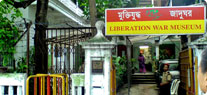
If you love to know the traditional and ancient heritage of Bangladesh. If you are quite studious and love to go through Series of ancient references in its bookish way, Try one from our range of Museum tours.
View Details
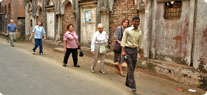
If you love to walk, If you have appetite for enjoying the nature and locality in its true form, If you have a palette for touching the earth by your own feet, then come have a fantastic trek in a part of Bangladesh. You would love it.
View Details
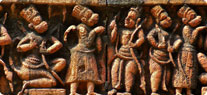
We have a long heritage of thousands of years. More importantly the twists and turns that our history demonstrates are dramatic and worth exploring.
View Details
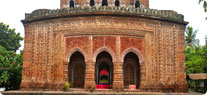
There is a 6th century BC city in Bogra, one 8th Century Buddhist Monastery in Naogaon, an 11th Century Mosque in Bagerhat and many more. We have a lot for your archaeology thirst. Just let us know how you want to do it.
View Details
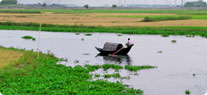
Bangladesh is a very beautiful country, indeed. This beauty even enriches in monsoon. If you want to experience a very exceptional tour , then monsoon options have something very attractive for you.
View Details